

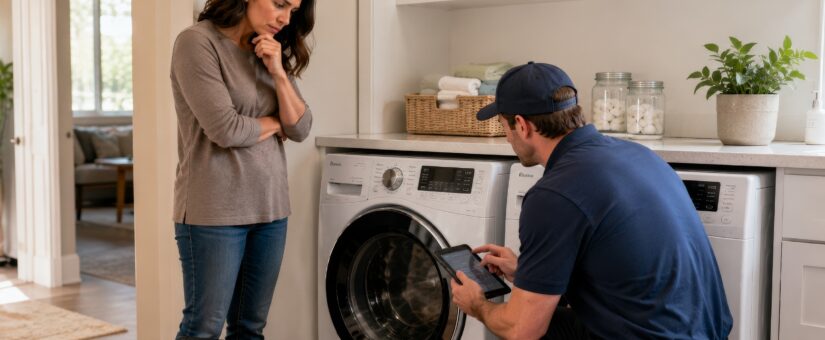
Repairing Modern Household Appliances
Repairing Modern Household Appliances
Twenty years ago, appliance repair was simpler. A washer that stopped spinning probably needed a belt. A dryer that stopped heating correctly pointed toward the heating element. A refrigerator that was not cool enough was no doubt a problem with the thermostat or start relay. Because appliances were made up of numerous independent parts, with a basic toolbox and a little patience, many homeowners could make a reasonable diagnosis and repair the machine themselves.
Today, modern appliances look similar from the outside and perform similar tasks, but their internal design has changed dramatically. Sensors, electronic control boards, variable-speed motors, and diagnostic software now manage many everyday functions in your appliances. These advances improve convenience and efficiency, but they also create challenges for do-it-yourselfers who rely on repair methods that worked on older machines.
The Design of Modern Appliances
Modern household appliances contain several systems that work together. The exact parts vary by appliance, but most newer washers, dryers, refrigerators, dishwashers, and ovens include these core components:
- Main control board
The appliance’s central computer receives information from sensors and sends commands to motors, heaters, pumps, valves, fans, and other parts. - User-interface board
Controls the display, buttons, touchscreen, knobs, indicator lights, and cycle selections. Some appliances combine this with the main control board. - Sensors
Monitor operating conditions and send reports to the control board. Common sensor examples include:- Temperature sensors
- Water-level or pressure sensors
- Moisture sensors
- Door and lid-position sensors
- Motor-speed sensors
- Vibration and load sensors
- Water-flow or water-clarity sensors
- Motors and drive components
Create movement inside the appliance. These may turn a washer drum, circulate dishwasher water, operate a refrigerator fan, or rotate a dryer drum. Belts, pulleys, gears, bearings, and couplings transfer that movement. - Pumps, fans, and compressors
Move water, air, or refrigerant. Washers and dishwashers use drain and circulation pumps. Refrigerators use fans and a compressor to remove heat. Dryers use a blower to move heated air. - Temperature components
Control temperature. Examples include dryer heating elements, oven elements, gas burners, refrigerator evaporators and condensers, dishwasher heaters, and defrost heaters. - Valves and switches
Control the flow of water, gas, air, or electricity. Common examples include water-inlet valves, gas valves, pressure switches, door switches, and relays. - Power-control components
Regulate and distribute electricity. Modern appliances may include power-supply boards, relays, capacitors, fuses, transformers, inverter boards, and motor-control modules. - Safety devices
Protect the appliance and household from dangerous conditions. These include thermal fuses, high-limit thermostats, door locks, overflow switches, leak sensors, flame sensors, and circuit protection. - Wiring harnesses and connectors
Carry electricity and information between the appliance’s components. A loose, corroded, burned, or damaged connection may prevent a working motor or sensor from responding, making the problem look like a failed part. - Mechanical structure and seals
Includes tubs, drums, racks, hinges, suspension rods, shock absorbers, gaskets, hoses, bearings, and door seals. These parts support movement and keep water, air, or heat contained. - Diagnostic and communication systems
Many modern appliances store error codes and run built-in diagnostic tests. Smart models may also include Wi-Fi modules, software, and communication boards.
Instead of working independently, modern appliances operate as a connected system. A perfectly good motor or pump may stop working due to a failed sensor, damaged wire, or weak power supply, which makes accurate diagnosis more important than simply replacing the part associated with the symptom.
Why DIY Appliance Repairs Fail
Unfortunately, replacing a part based only on the symptom ranks among the most common DIY mistakes. For example, a refrigerator that isn’t cooling does not automatically need a compressor. A washer that stops spinning may not just need a belt. And a dishwasher that leaves dishes wet after the final cycle might not need a new heating element; it may simply need a rinse aid added, or a different method of loading the dishes.
Error codes built into the user interface board are common. Ignoring or not understanding these error codes also causes trouble for DIYers. A code doesn’t necessarily identify the failed part, but it does identify the system that needs further testing.
Some choose to repeatedly unplug an appliance, which may temporarily clear an error code or fault but doesn’t fix the cause of the problem. It may also erase stored information that could help a professional technician find and repair the main problem.
Installing a new control board without testing the connected components (which cost significantly less than the control board) may also result in another repair failure.
As you can see, modern appliance repair requires a careful, step-by-step diagnosis rather than guesswork.
Get an Honest Appliance Diagnosis
Appliance design has improved efficiency, convenience, and performance over the past 20 years, but those improvements have also made repairs more complex. With electronics, sensors, specialized motors, and connected systems, appliances rarely respond well to trial-and-error DIY repairs. That’s where River City Appliance comes in. Our experienced technicians carefully inspect, accurately diagnose, and repair most makes and models of everyday household appliances. Before repairing, we will always tell you honestly whether a repair makes financial sense. Benefit from our exceptional service by contacting River City Appliance today!
- Posted by River City Appliance Blog
- On September 10, 2026
- 0 Comment

0 Comments